Independent buying guidance • Practical product comparisons • Road-ready automotive advice

When learning how to choose a portable jump starter, start with three checks: your vehicle’s starting-battery voltage, its battery chemistry, and the manufacturer’s engine compatibility rating. Then compare safety features, cable reach, charging requirements, and storage limits.
A compatible jump starter supplies temporary starting assistance without another vehicle. For a first-time car owner, the useful purchase is one that matches the car and is easy to maintain. This guide explains how to read the specifications and build a shortlist.
Find the jump-starting section in your owner’s manual and check the starting-battery label. Match the jump starter’s output to the voltage the vehicle requires. Vehicle size alone cannot tell you whether a particular unit is compatible.
For a hybrid or electric vehicle, consult its specific jump-starting instructions before shopping. Identify the auxiliary battery and approved connection points. A portable jump starter must never be connected to the high-voltage traction battery.
Product descriptions can mention both the battery inside the jump starter and the vehicle batteries it supports. These are separate specifications. A lithium-powered jump starter does not automatically support jump-starting a lithium vehicle battery.
For example, NOCO’s GB40 specifications list a lithium-ion internal battery and compatibility with 12-volt lead-acid vehicle batteries. Check this distinction on every model you consider, including any restrictions for your vehicle’s battery chemistry.
Record your engine’s displacement and whether it uses gasoline or diesel. Compare that information with the jump starter manufacturer’s application limits. Use the diesel rating for a diesel vehicle; a gasoline engine rating does not establish diesel compatibility.
As a specification-reading example, NOCO lists the GB40 for gasoline engines up to 6.0 liters and diesel engines up to 3.0 liters. Those are that model’s published limits. Other products need their own compatibility checks. Ask the manufacturer when your exact application is unclear.
Peak amps describe a brief maximum output. Cranking or starting ratings describe output under stated test conditions. Their meaning depends on the test method, temperature, and duration, so avoid treating differently labeled numbers as interchangeable.
Weego’s explanation of starting ratings illustrates how lead-acid and lithium jump starter measurements can differ. Check whether each manufacturer publishes the conditions behind its numbers. A bigger advertised peak figure alone is an incomplete basis for choosing between brands.
Similarly, the CCA number on your car battery is a battery performance rating. It does not automatically translate into a matching jump starter peak-amp requirement. Begin with the manufacturer’s supported vehicle applications and ask for confirmation if necessary.
Lithium jump starters commonly offer a compact design, while traditional lead-acid units can be bulkier. Compare actual dimensions, weight, cable storage, and carrying arrangements. Battery chemistry by itself does not establish a product’s charging speed, service life, or overall value.
Look for documented reverse-polarity, short-circuit, and overheating protection, plus clear connection and fault indicators. Read how the exact model responds to a fault. These features assist the user; correct connections and the operating instructions still matter.
Pay particular attention to override modes. NOCO warns that GB40 manual override disables its safety features and supplies no additional power. A beginner should seek qualified help when normal operation fails rather than experiment with an override.
Check whether the supplied clamps can grip your vehicle’s designated jump points and whether the cables can reach them without stretching. Use the owner’s manual to locate those points before buying. Cable length is especially relevant when the battery is difficult to access.
Choose readable indicators, clearly marked polarity, and instructions you can understand. Keep the supplied cables and approved accessories together. Follow both manuals for connection points, connection order, cranking attempts, and required rest periods.
The input specification explains how to recharge the jump starter itself. USB output specifications explain what it can supply to a phone or another accessory. A USB port may serve one function or both, depending on the model.
Before checkout, confirm the required charger, cable, and charging protocol, and check what is included. Compare published recharge times using the specified charger. An advertised fast-charge feature may require an adapter sold separately.
A flashlight or phone-charging port can be useful, but accessory use consumes stored energy. Check the charge indicator before relying on the unit for starting assistance.
These temperature limits may differ. Check all three in the exact model’s manual, together with its recharge schedule. A claim about cold-weather operation does not establish that charging or long-term storage is allowed at the same temperature.
Choose a secure, dry storage location that meets those limits. A closed vehicle can become very hot, so physical fit in a glove compartment is only one consideration. Check the unit before a trip and recharge according to its instructions and charge indicator.
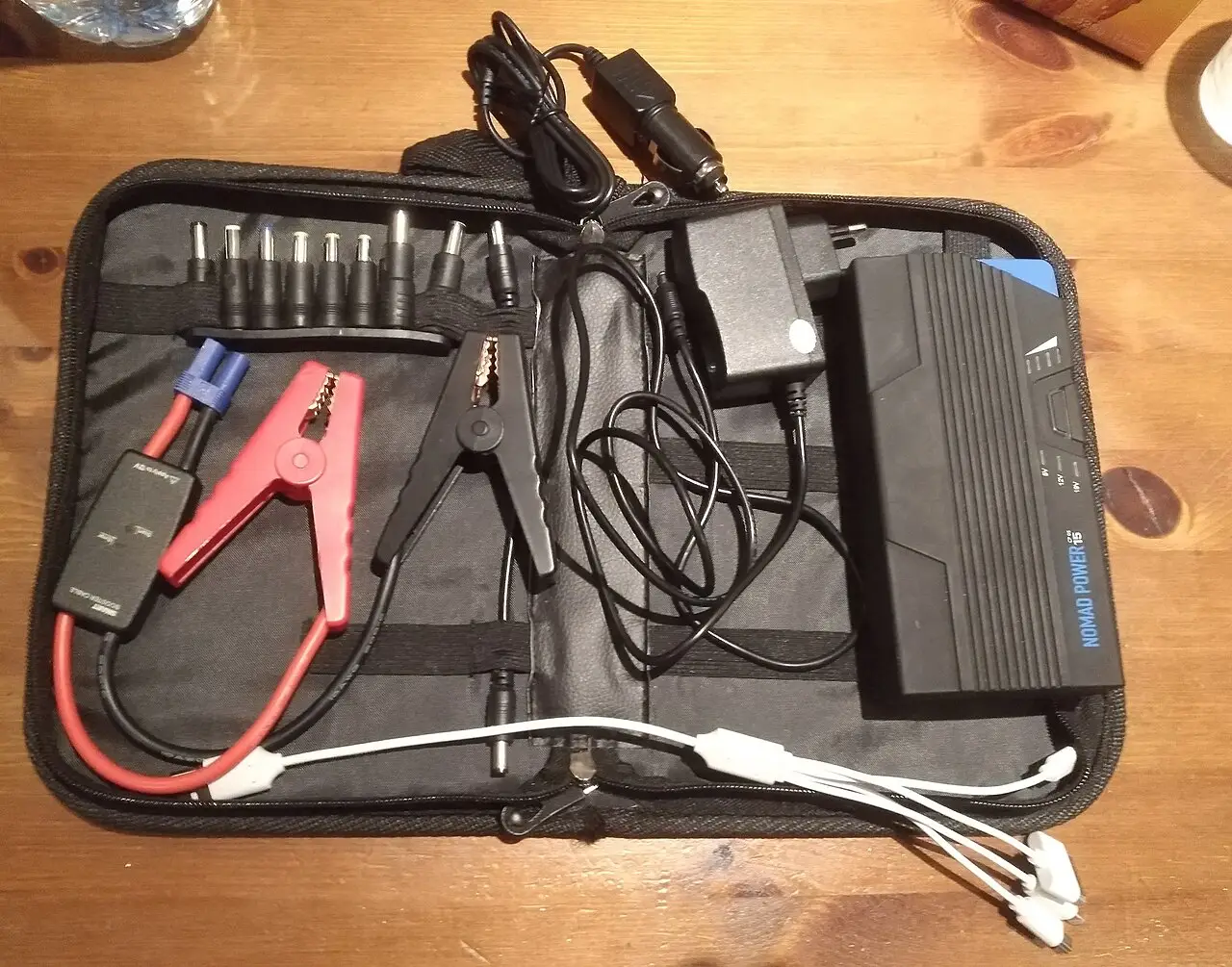
Example jump starter kit; supplied accessories vary by model. Photo: Sebleouf / Wikimedia Commons, CC BY-SA 4.0. Resized for web.
Compare the complete setup: jump starter, required charging adapter, cables, and any case you need. Review warranty coverage, support availability, return terms, and the cost of approved replacement accessories.
For occasional personal use, prioritize confirmed compatibility, understandable controls, and manageable upkeep. Evaluate extra ports or an integrated compressor against how often you will use them. Compare current offers for the same model and included accessories.
Once those checks are complete, use our jump starter comparison guide to build a shortlist. Confirm each exact model’s current specifications before purchasing.
This official NOCO video demonstrates the GB40 in use. Controls can vary by product version. Follow the current jump starter instructions and your vehicle’s manual for approved connection points and operating limits.
Video: NOCO. Watch the original demonstration on YouTube.
Match the manufacturer’s supported engine type and displacement, starting-battery voltage, and battery chemistry. There is no single amp figure that covers every small car or SUV. If the application is not clearly supported, contact the manufacturer before buying.
A standalone jump starter provides temporary starting assistance. A compatible battery charger replenishes the vehicle battery over time. Some products combine functions, so check the manual. Repeated starting trouble calls for diagnosis of the battery and charging system.
Check the manufacturer’s storage instructions and temperature limits first. Secure the unit and protect its cables. If conditions inside your parked car fall outside the permitted limits, choose another storage location.
Follow the exact model’s recharge schedule and charge indicator. Check it after use and before a trip. Charge retention varies, so a universal three- or six-month interval is unsuitable for every product.
Stop and follow the troubleshooting instructions and attempt limits. Never jump-start a damaged, leaking, or frozen battery. If the cause is unclear or the vehicle still will not start, contact roadside assistance or a qualified technician.
The right portable jump starter for your car combines verified compatibility with usable clamps, clear protections, and charging and storage requirements you can meet. Write down your vehicle details, complete the checklist, and compare suitable models on their full cost and support.
Featured photo: Tony Webster / Wikimedia Commons, CC BY 2.0. Resized for web. The photograph shows an earlier GB40 design.
The model example uses published manufacturer specifications. Consult the manual supplied with your exact product and your vehicle’s owner’s manual before use.
When learning how to choose a portable jump starter, start with three checks: your vehicle’s starting-battery voltage, its battery chemistry, and the manufacturer’s engine compatibility rating. Then compare safety features, cable reach, charging requirements, and storage limits. Understanding how to choose a portable jump starter is crucial for every car owner.
A compatible jump starter supplies temporary starting assistance without another vehicle. For a first-time car owner, the useful purchase is one that matches the car and is easy to maintain. This guide explains how to read the specifications and build a shortlist of how to choose a portable jump starter that suits your needs.
Find the jump-starting section in your owner’s manual and check the starting-battery label. Match the jump starter’s output to the voltage the vehicle requires. Vehicle size alone cannot tell you whether a particular unit is compatible with how to choose a portable jump starter.
For a hybrid or electric vehicle, consult its specific jump-starting instructions before shopping. Identify the auxiliary battery and approved connection points. A portable jump starter must never be connected to the high-voltage traction battery. Understanding how to choose a portable jump starter involves knowing these specifics.
Product descriptions can mention both the battery inside the jump starter and the vehicle batteries it supports. These are separate specifications. A lithium-powered jump starter does not automatically support jump-starting a lithium vehicle battery. When learning how to choose a portable jump starter, be aware of these distinctions.
For example, NOCO’s GB40 specifications list a lithium-ion internal battery and compatibility with 12-volt lead-acid vehicle batteries. Check this distinction on every model you consider, including any restrictions for your vehicle’s battery chemistry.
Record your engine’s displacement and whether it uses gasoline or diesel. Compare that information with the jump starter manufacturer’s application limits. Use the diesel rating for a diesel vehicle; a gasoline engine rating does not establish diesel compatibility. This is vital when learning how to choose a portable jump starter.
As a specification-reading example, NOCO lists the GB40 for gasoline engines up to 6.0 liters and diesel engines up to 3.0 liters. Those are that model’s published limits. Other products need their own compatibility checks. Ask the manufacturer when your exact application is unclear.
Peak amps describe a brief maximum output. Cranking or starting ratings describe output under stated test conditions. Their meaning depends on the test method, temperature, and duration, so avoid treating differently labeled numbers as interchangeable. Knowledge on how to choose a portable jump starter will help here.
Weego’s explanation of starting ratings illustrates how lead-acid and lithium jump starter measurements can differ. Check whether each manufacturer publishes the conditions behind its numbers. A bigger advertised peak figure alone is an incomplete basis for choosing between brands.
Similarly, the CCA number on your car battery is a battery performance rating. It does not automatically translate into a matching jump starter peak-amp requirement. Begin with the manufacturer’s supported vehicle applications and ask for confirmation if necessary.
Lithium jump starters commonly offer a compact design, while traditional lead-acid units can be bulkier. Compare actual dimensions, weight, cable storage, and carrying arrangements. Battery chemistry by itself does not establish a product’s charging speed, service life, or overall value. This is another factor in how to choose a portable jump starter.
Look for documented reverse-polarity, short-circuit, and overheating protection, plus clear connection and fault indicators. Read how the exact model responds to a fault. These features assist the user; correct connections and the operating instructions still matter.
Pay particular attention to override modes. NOCO warns that GB40 manual override disables its safety features and supplies no additional power. A beginner should seek qualified help when normal operation fails rather than experiment with an override.
Check whether the supplied clamps can grip your vehicle’s designated jump points and whether the cables can reach them without stretching. Use the owner’s manual to locate those points before buying. Cable length is especially relevant when the battery is difficult to access. When considering how to choose a portable jump starter, these practical aspects are crucial.
Choose readable indicators, clearly marked polarity, and instructions you can understand. Keep the supplied cables and approved accessories together. Follow both manuals for connection points, connection order, cranking attempts, and required rest periods.
The input specification explains how to recharge the jump starter itself. USB output specifications explain what it can supply to a phone or another accessory. A USB port may serve one function or both, depending on the model. Consider how to choose a portable jump starter that balances these needs.
Before checkout, confirm the required charger, cable, and charging protocol, and check what is included. Compare published recharge times using the specified charger. An advertised fast-charge feature may require an adapter sold separately.
A flashlight or phone-charging port can be useful, but accessory use consumes stored energy. Check the charge indicator before relying on the unit for starting assistance.
These temperature limits may differ. Check all three in the exact model’s manual, together with its recharge schedule. A claim about cold-weather operation does not establish that charging or long-term storage is allowed at the same temperature.
Choose a secure, dry storage location that meets those limits. A closed vehicle can become very hot, so physical fit in a glove compartment is only one consideration. Check the unit before a trip and recharge according to its instructions and charge indicator.
Compare the complete setup: jump starter, required charging adapter, cables, and any case you need. Review warranty coverage, support availability, return terms, and the cost of approved replacement accessories. This is part of how to choose a portable jump starter wisely.
For occasional personal use, prioritize confirmed compatibility, understandable controls, and manageable upkeep. Evaluate extra ports or an integrated compressor against how often you will use them. Compare current offers for the same model and included accessories.
Once those checks are complete, use our jump starter comparison guide to build a shortlist of how to choose a portable jump starter. Confirm each exact model’s current specifications before purchasing.
Match the manufacturer’s supported engine type and displacement, starting-battery voltage, and battery chemistry. There is no single amp figure that covers every small car or SUV. If the application is not clearly supported, contact the manufacturer before buying.
A standalone jump starter provides temporary starting assistance. A compatible battery charger replenishes the vehicle battery over time. Some products combine functions, so check the manual. Repeated starting trouble calls for diagnosis of the battery and charging system.
Check the manufacturer’s storage instructions and temperature limits first. Secure the unit and protect its cables. If conditions inside your parked car fall outside the permitted limits, choose another storage location.
Follow the exact model’s recharge schedule and charge indicator. Check it after use and before a trip. Charge retention varies, so a universal three- or six-month interval is unsuitable for every product.
Stop and follow the troubleshooting instructions and attempt limits. Never jump-start a damaged, leaking, or frozen battery. If the cause is unclear or the vehicle still will not start, contact roadside assistance or a qualified technician.
The right portable jump starter for your car combines verified compatibility with usable clamps, clear protections, and charging and storage requirements you can meet. Write down your vehicle details, complete the checklist, and compare suitable models on their full cost and support, especially on how to choose a portable jump starter.
The model example uses published manufacturer specifications. Consult the manual supplied with your exact product and your vehicle’s owner’s manual before use.