Independent buying guidance • Practical product comparisons • Road-ready automotive advice

The jump starter vs battery charger decision comes down to the job you need done: temporary starting assistance, recharging, or maintaining a battery during storage. These functions can appear in separate devices or in a product that combines both. Understanding the jump starter vs battery charger options will aid your decision-making.
Understanding the jump starter vs battery charger distinctions can help you make a more informed decision regarding battery care and vehicle readiness.
For a first-time car owner, identifying that job makes shopping easier. This guide compares typical portable jump packs with plug-in automotive battery chargers and explains which features to verify before buying. This comparison is crucial in understanding the jump starter vs battery charger functionalities.
A battery-powered jump starter stores energy internally and supplies temporary starting assistance through its clamps. It needs sufficient charge before use and must support the vehicle’s battery and engine application. When weighing jump starter vs battery charger, consider your immediate needs.
Starting assistance does not establish that the vehicle battery is fully recharged or healthy. For example, NOCO’s GB40 guidance specifically distinguishes its Boost jump-starting function from charging a car battery. USB phone-charging ports are another separate feature.
A charger supplies energy to recharge a compatible battery over time. The plug-in models discussed here require a suitable electrical outlet during operation. Select the correct voltage, battery mode, and permitted charging current. Check the charger’s stated battery-capacity range in amp-hours (Ah), too.
Some chargers include an engine-start function. Schumacher’s SC1281L product page, for example, lists separate charging and engine-start functions and specifies AC-powered operation. Read the exact model’s instructions to understand which functions it offers when considering the jump starter vs battery charger features.
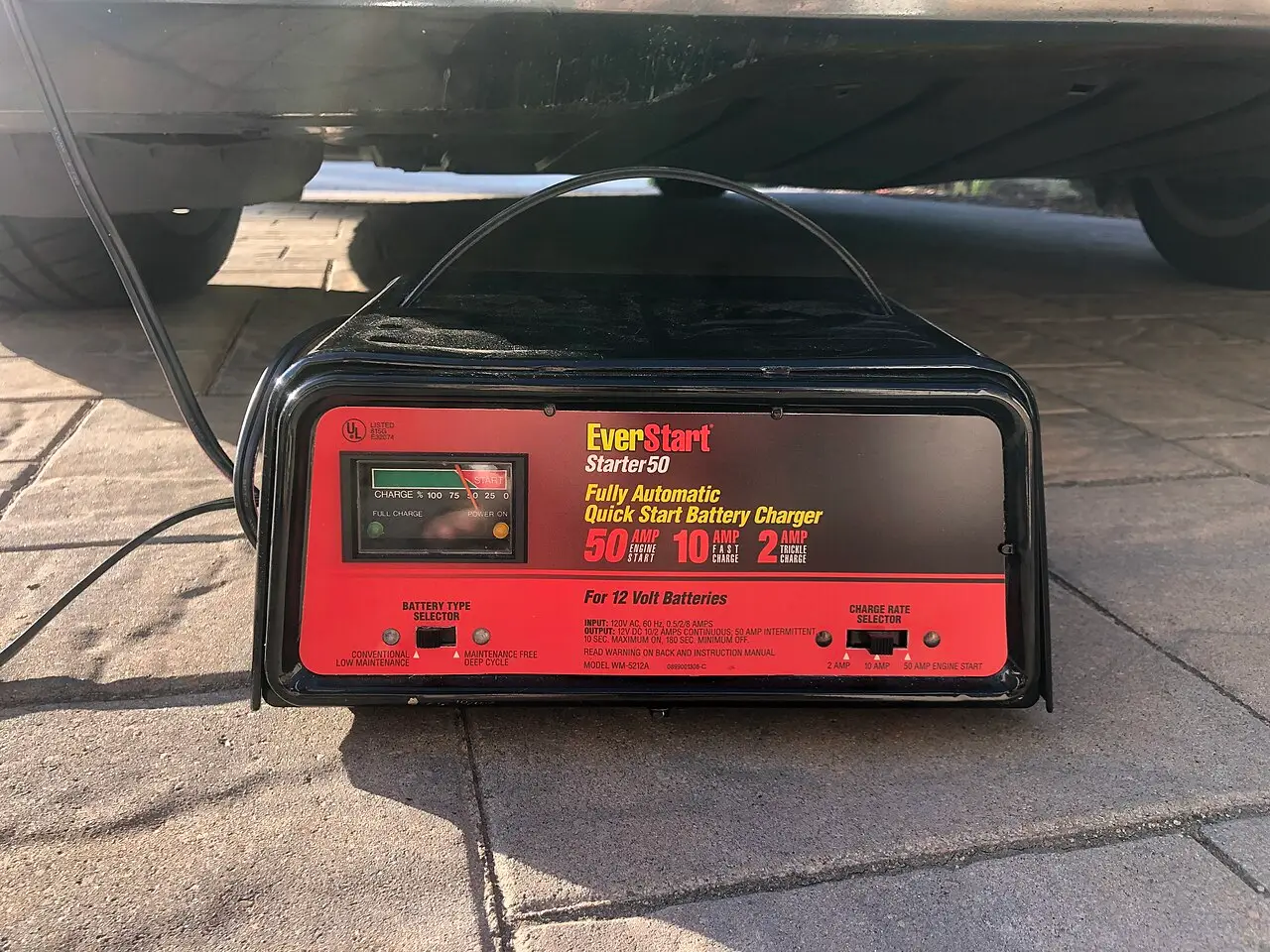
An older EverStart charger illustrates separate charging and engine-start controls. Features vary by model. Photo: FASTILY / Wikimedia Commons, CC BY-SA 4.0. Resized for web.
A maintainer is designed to manage charge during periods of non-use. Some smart chargers also provide a maintenance mode, while other chargers require disconnection after charging. A low charging rate alone does not establish suitability for extended connection.
For seasonal storage, verify that the manufacturer permits the intended maintenance use, battery type, and connection period. Follow its inspection requirements. “Automatic” or “smart” on the box is a reason to check the instructions, not a substitute for them.
| Question | Portable Jump Starter | Plug-In Battery Charger |
|---|---|---|
| Main job | Temporary assistance to start a compatible vehicle | Recharge a compatible vehicle battery over time |
| Energy source during use | Its charged internal battery | A suitable external electrical supply |
| Can it assist engine starting? | Yes, within its approved vehicle application and operating limits | Only if a dedicated engine-start function is specified and suitable |
| Can it maintain a stored battery? | A standard jump-starting function does not provide maintenance charging | Only if the model supports the intended maintenance use |
| What needs checking? | Voltage, supported battery type, engine rating, clamps, and charge status | Voltage, supported battery type, charging mode, output, and power supply |
| Readiness requirement | Recharge and store the pack according to its manual | Have suitable power, connections, and time for charging |
Combination products may offer additional functions. Compare the documented capabilities of the exact model, including any different limits for each mode, particularly in the jump starter vs battery charger context.
Imagine returning to a parked car after leaving a light on. If the starting battery is discharged and both manuals permit jump-starting, a charged portable pack may help without another vehicle or an outlet. The vehicle still needs appropriate follow-up charging and assessment, highlighting the importance of choosing between jump starter vs battery charger.
Before choosing a pack for your emergency kit, check whether you can maintain its charge and meet its storage limits. A unit left unused beyond its recharge schedule may be unavailable when needed. This is a common mistake in the jump starter vs battery charger decision process.
If you have access to suitable power and time to recharge the battery, a charger addresses that task directly. Check that its output and charging mode suit the installed battery.
Charging time depends on the battery’s capacity, state of charge, condition, and the charger’s operating cycle. Use the model’s guidance rather than assuming every battery will recharge overnight. Adding charge does not prove that a battery can still deliver reliable starting performance when contrasting jump starter vs battery charger.
For an infrequently used car, investigate a compatible maintainer or charger with an approved maintenance mode. Confirm the vehicle manufacturer’s requirements for connections and storage charging.
Some products combine charging and maintenance. The NOCO GENIUS5 is one manufacturer-documented example. Its functions illustrate why checking the model specification is more useful than relying on the broad label “battery charger,” particularly when discussing jump starter vs battery charger.
A driver who wants roadside starting assistance and also charges a seasonal vehicle at home has two different needs. Separate devices may suit that routine. Prioritize the job you currently need and compare any combination product against both sets of requirements before spending more, especially in the jump starter vs battery charger context.
Check the vehicle manual and battery label. Match the required voltage and supported battery type; vehicle size alone is insufficient. AGM, or absorbent glass mat, is a lead-acid battery design, as described in Interstate Batteries’ glossary.
For lithium vehicle batteries, verify the exact supported chemistry and any battery-management requirements. The battery inside a lithium jump starter is a separate specification from the vehicle batteries it can support, especially when weighing jump starter vs battery charger.
A jump pack’s advertised peak-current figure and a charger’s charging-current rating describe different operating tasks. Compare jump starters using their supported engine applications and published test conditions. Compare chargers using battery compatibility, permitted charging current, and available modes, all relevant to the jump starter vs battery charger discussion.
Locate the approved connection points in the vehicle manual. Check cable reach, polarity markings, fault indicators, and the device’s instructions. For a plug-in charger, also verify the input voltage and outlet requirements. When considering jump starter vs battery charger, understand these basics.
Documented protections can assist with certain faults, but their coverage depends on the model and mode. Follow connection instructions, ventilation requirements, temperature limits, and permitted operating periods. Keep cables clear of moving parts and use the protective equipment specified by the manuals.
Do not attempt to jump-start or charge a physically damaged, leaking, swollen, or frozen battery. Stop if the equipment reports a fault or conditions fall outside its instructions. Avoid experimenting with override or repair modes when the battery’s condition is uncertain.
If starting trouble returns after a jump or recharge, arrange professional testing. A successful jump or recharge alone does not establish the cause of repeated discharge or prove that the vehicle is ready for continued use. In understanding jump starter vs battery charger, this is critical.
There is no fixed price order between these categories. Compare complete setups for your intended job, including any required adapter, approved charging leads, case, and other accessories.
If portable starting assistance is your priority, use our jump-starter comparison guide to build a shortlist, then confirm each model’s current documentation.
NOCO’s official GENIUS5 tutorial shows how charging modes are selected. This is a model-specific example. Use only the mode approved for your battery and follow the current vehicle and charger manuals, including any additional conditions for repair modes.
Video: NOCO. Watch the original tutorial on YouTube.
A standard jump-starting function supplies temporary starting assistance. It does not perform a full vehicle-battery charging cycle. A combination product needs an explicitly documented charging function; USB outputs for phones do not establish that capability.
Some chargers have a dedicated engine-start function. Ordinary charging mode does not establish immediate starting capability. Verify the specific mode, compatibility, power requirements, and operating limits in the manual. This is an essential point in the jump starter vs battery charger comparison.
The functions differ, but one product may provide both. Check whether the manufacturer approves maintenance charging for your battery and intended storage period. Do not assume every low-output or automatic charger can remain connected indefinitely, especially when comparing jump starter vs battery charger.
Repeated discharge needs diagnosis. Recharging or starting the vehicle does not identify the underlying cause. Have the battery and charging system checked rather than treating repeated jumps as routine maintenance. This distinction is key in the jump starter vs battery charger considerations.
Choose a compatible jump starter for portable starting assistance, a suitable charger for recharging, and an approved maintenance function for storage. Base the purchase on the job, your vehicle’s requirements, and the upkeep you can provide. Understanding the jump starter vs battery charger options will ensure you make the right choice.
Featured photo: Tony Webster / Wikimedia Commons, CC BY 2.0. Resized for web. An earlier GB40 design is shown.
Manufacturer examples illustrate published functions. Verify the manual supplied with your exact product and your vehicle’s owner’s manual before use.