
p>To use a portable tire inflator, find your vehicle’s recommended cold tire pressure, measure the tire, connect the equipment as directed and select the correct pressure unit and target. Inflate within the model’s operating limits, then confirm the final pressure with a separate gauge.
This beginner’s guide explains how to use a portable tire inflator and how to inflate car tires during routine maintenance with a compatible vehicle-powered or cordless model. A tire with visible damage or repeated pressure loss needs professional attention.
As an Amazon Associate I earn from qualifying purchases. Read our affiliate disclosure.
Before You Start: Check Pressure, Power and Run-Time Limits
Keep your vehicle manual and the portable tire inflator instructions nearby. Gather a separate tire pressure gauge and work in a safe parking location, clear of moving traffic.
- Find the target pressure. Use the vehicle’s Tire and Loading Information label or owner’s manual. Front and rear targets can differ. The tire sidewall’s maximum pressure is not the vehicle’s normal inflation target.
- Check cold tires. NHTSA defines cold tires as tires on a vehicle that has not been driven for at least three hours. Plan routine checks around a cold reading.
- Inspect the equipment. Look for damaged hoses, connectors, cords or battery packs before use.
- Read the operating limits. Identify the required power source, maximum continuous run time and cooling instructions before switching on.
Duty cycle describes operating time within a run-and-rest cycle under specified conditions. Follow the manufacturer’s stated schedule and conditions. An available power supply does not cancel a compressor’s cooling requirements.
Prepare a 12V or Cordless Tire Inflator
| Type | Power preparation | Practical consideration |
|---|---|---|
| Vehicle-powered | Confirm the specified connector and the vehicle outlet’s permitted load. | The cable and hose must reach each tire without strain. |
| Cordless | Check charge level and approved battery and charger compatibility. | Plan charging around the amount of inflation required. |
For a 12V model, check both manuals for vehicle ignition or engine requirements. Use the supplied connection method and the specified electrical rating. If engine operation is required, work outdoors; never run a vehicle in a garage or other enclosed space.
For a cordless model, charge it as directed before starting. Charging connections and battery arrangements vary: some units have a built-in battery, while others use a removable tool battery.
When comparing models, maximum PSI alone is not a measure of inflation speed. Look for relevant tire-size compatibility, airflow information or inflation tests with clearly stated conditions.
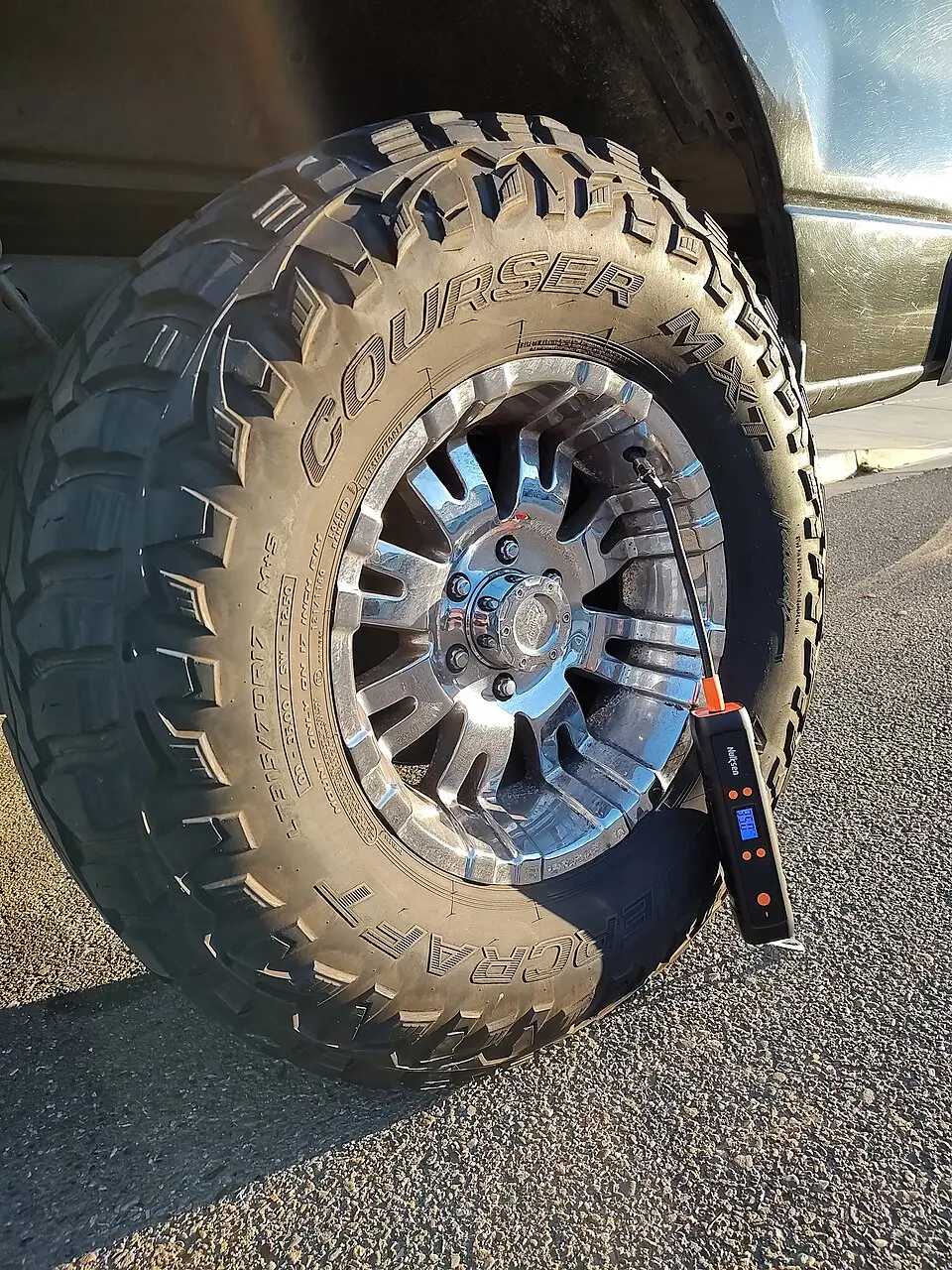
A cordless inflator connected to an all-terrain tire. Support your own unit as directed in its manual.
Cordless Inflator: Manufacturer Demonstration
Slime demonstrates its Cordless Tire Inflator #40084. Follow the charging and operating instructions for your exact model.
How to Use a Portable Tire Inflator: Step by Step
Use the following sequence alongside your model’s instructions. Its connection order, controls and limits take priority.
1. Measure the Tire’s Starting Pressure
Remove the valve cap and seat the separate gauge firmly on the valve. Record the reading and compare it with that tire’s target. Confirm how much air is needed before running the pump.
2. Connect the Hose and Approved Power Source
Keep the pump switched off while preparing its connections. Attach the hose and connect power in the order specified by the manual. Keep the hose free from sharp bends and the unit stable.
Connector mechanisms vary. Slime, for example, documents both lift-to-lock and down-to-lock hose heads. Check which locking mechanism your connector uses.
3. Check the Tire Inflator Pressure Setting
Match the display or gauge unit to the target pressure: PSI, bar or kPa. On a preset model, enter and confirm the target before inflation. On a manual model, identify the target on the gauge and be ready to stop the pump yourself. Review any saved setting before moving to another tire.
4. Inflate While Monitoring Pressure and Run Time
Start the pump as instructed and stay with it. Watch pressure and elapsed running time. Take the required cooling breaks before continuing, including between tires when needed.
If the model has automatic pressure shut-off, use it as directed and still check the result. Follow its troubleshooting instructions if it stops unexpectedly or reports an error.
5. Stop, Disconnect and Recheck
At the target, stop the pump and follow the manual’s shutdown and disconnection procedure. Treat recently used hose fittings as potentially hot. Measure again with the separate gauge once the inflator hose is removed.
If the reading is below the target, reconnect and add air within the operating limits. If it is above the target, use your gauge’s pressure-release feature, if fitted, to release a little air. Recheck after each adjustment.
6. Replace the Cap and Complete the Check
Refit the valve cap and repeat for the remaining tires, using each tire’s specified target. Include the spare where applicable. Note any tire that repeatedly loses pressure and arrange a tire-service inspection.
12V Inflator: Manufacturer Demonstration
Manufacturer video: Slime 12V Tire Inflator #40050. Controls and operating limits vary by model.
Common Tire Inflation Mistakes
- Reusing the wrong setting. Check the pressure unit and target for every tire.
- Skipping the starting measurement. Establish the current pressure before deciding how much air to add.
- Running past the cooling limit. Plan the whole job around the stated run-and-rest instructions.
- Expecting air to repair damage. An inflator cannot repair the cause of a leak.
Store the Inflator Ready for Its Next Use
Switch off, disconnect power and allow the unit to cool as instructed before packing it away. Coil the hose and cable without tight bends, keep accessories together and inspect connections periodically.
For cordless models, follow the manufacturer’s storage charge level, temperature limits and recharge interval. These details vary. Remove a removable battery when the instructions require it. Check the equipment’s storage limits before leaving it in a vehicle that may become very hot or cold.
Choose an Inflator That Fits Your Car and Routine
Before buying, make a short list of requirements: supported tire sizes, an approved power source, enough hose reach, a readable gauge, suitable operating limits and the accessories you need. Check whether a battery, charger or power adapter is included.
For a closer look at specific options, read our Best Portable Tire Inflators comparison. Use the features and limitations discussed there to narrow your choices, then confirm the exact model’s current specifications before buying.
Frequently Asked Questions
How Often Should I Check Tire Pressure?
NHTSA recommends checking at least once a month when tires are cold. Include the spare where applicable, and use the vehicle’s specified pressure.
Can I Use an Inflator on a Completely Flat Tire?
Check the tire’s condition and the equipment’s permitted use first. A flat tire may need inspection or repair. For visible damage or a tire that will not maintain pressure, arrange professional tire service or roadside assistance.
Can It Inflate Balls, Bicycle Tires or Air Mattresses?
Only when the inflator and item support the intended use, pressure range and adapter. Check the instructions for both. A high-pressure tire function and a high-volume inflatable function are different; a unit may support one or both.
Photo Credits
Photo: Inflating Temporary Spare – Tire Inflator – Air Compressor © Tony Webster / Wikimedia Commons, CC BY 2.0. Reduced-size copy.
Photo: Big tire being inflated in the sun by FUBARMAXUSMC / Wikimedia Commons, CC BY-SA 4.0. Reduced-size copy.
Sources and How This Guide Was Prepared
This guide draws on public tire-maintenance guidance and manufacturer documentation. The examples explain operating decisions; controls, connections and limits must be checked against the exact equipment.
- NHTSA TireWise: vehicle-label pressure, cold readings, pressure checks and tire condition.
- Slime hose-head instructions: differences between locking mechanisms.
- Slime Cordless Tire Inflator guidance: built-in battery and model-specific charging arrangements.
- DEWALT DCC020I instruction manual: operation, pressure modes, batteries and storage.
- VIAIR technical FAQ: power requirements and duty-cycle concepts.
- CDC carbon monoxide guidance: vehicle exhaust and garage safety.
Finally, mastering how to use a portable tire inflator will empower you as a car owner.
By following this guide on how to use a portable tire inflator, you’ll be well-equipped for any situation.
This guide covers everything on how to use a portable tire inflator correctly.
Understanding how to use a portable tire inflator can enhance your driving safety.
To be prepared, you should know how to use a portable tire inflator for emergency situations.
Mastering how to use a portable tire inflator can prevent unexpected flat tires.
In this guide, learn how to use a portable tire inflator effectively and safely.
Every car owner should understand how to use a portable tire inflator to maintain tire pressure.
Knowing how to use a portable tire inflator is crucial, especially during long trips.
Follow these steps for how to use a portable tire inflator and ensure your tires are always ready for the road.
This article will demonstrate how to use a portable tire inflator for effective tire maintenance.
Understanding how to use a portable tire inflator can save you time and money at the gas station.
With this guide on how to use a portable tire inflator, you can inflate tires efficiently and safely.
Learning how to use a portable tire inflator is an essential skill for any vehicle owner.