Independent buying guidance • Practical product comparisons • Road-ready automotive advice

To choose a tire pressure gauge for your car, start with the pressures recommended by your vehicle manufacturer. Then compare each gauge’s working range, accuracy specification, valve connection, and readability. Check battery requirements and operating conditions before deciding which model fits your routine.
Digital, dial, and pencil gauges can each serve a useful purpose. This guide explains their practical differences and gives you a checklist for comparing individual products.
A tire pressure gauge measures the air pressure inside a tire. Depending on the model, it displays the result in PSI, kPa, bar, or several selectable units. A standalone gauge measures pressure; adding air requires a separate pump or an inflator with a measuring function.
Tire pressure affects handling, tire wear, and fuel consumption. Use a gauge to compare the measured pressure with the recommendation for your vehicle. Tire appearance alone is an unreliable way to decide whether pressure is correct. NHTSA’s TireWise guidance explains why regular pressure checks matter.
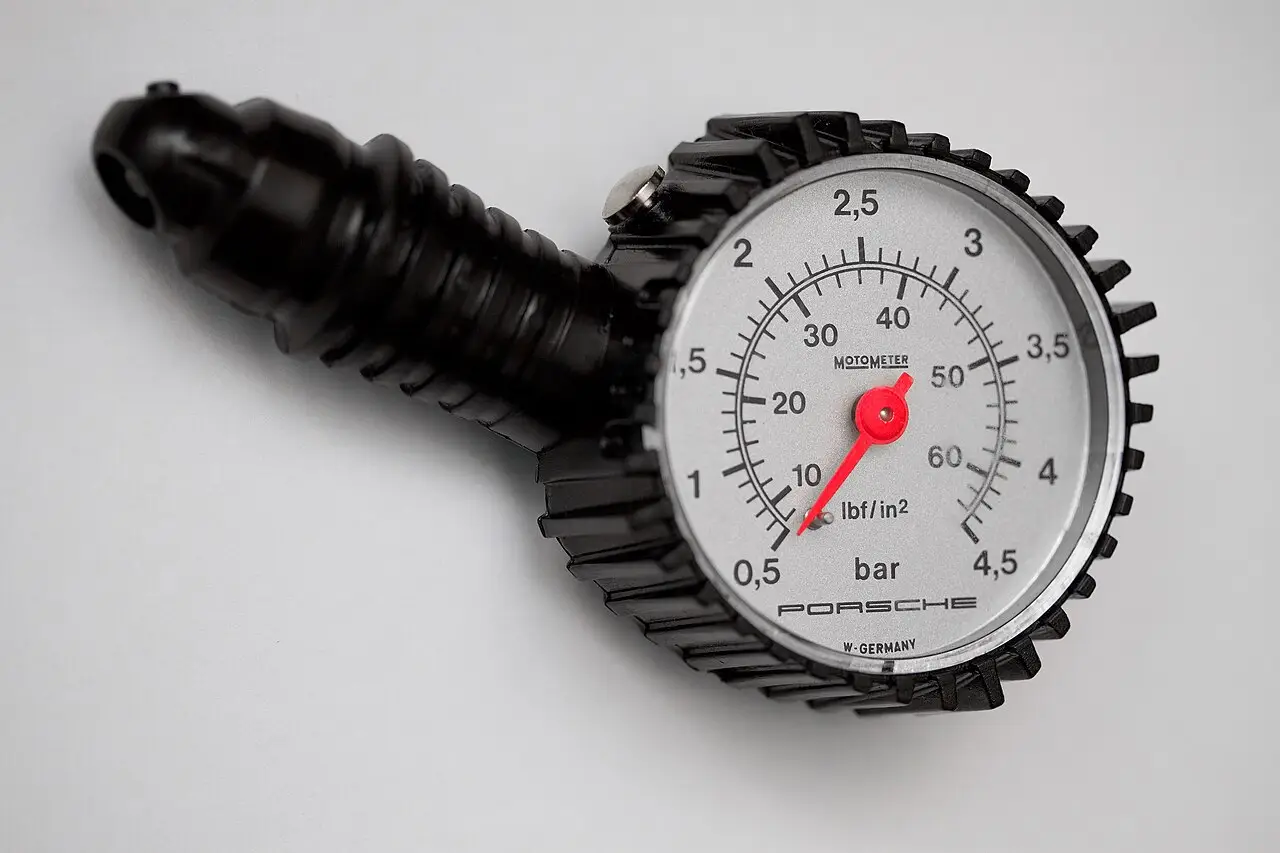
A classic dial tire pressure gauge showing bar and psi scales. Photo: Antti / Wikimedia Commons · CC BY 2.0. Resized for web use.
Digital gauges show numbers on a screen. Some models include a backlight, selectable units, automatic shutoff, or a reading-hold function. Check the exact feature list and whether the display remains readable from your working position.
Most handheld digital gauges need batteries. Their accuracy and operating limits depend on the particular instrument. Choose one by its published specifications, rather than assuming that every digital model will outperform every mechanical gauge.
A dial gauge uses a pointer and graduated scale. A basic mechanical model measures pressure without batteries. Some designs include a hose, swivel chuck, or pressure-release button, which may make reaching the valve easier.
Check the size of the markings and whether the instrument holds its reading after disconnection. A protective cover is useful, but it does not establish accuracy or make a gauge immune to damage.
A pencil tire pressure gauge uses a sliding indicator and fits into a small storage space. A basic mechanical version needs no battery. Before buying, check that you can clearly distinguish the scale divisions and the units printed on it.
Ranges differ between models. For example, Milton lists its S-921 pencil gauge for 5–50 PSI. Confirm that the selected range covers every tire you intend to check, including the spare where applicable.
Resolution is the smallest displayed step or scale division. Accuracy describes how closely the reading is specified to match the actual pressure under stated conditions. More decimal places do not establish a smaller measurement error.
For a concrete example, JACO’s ElitePro Digital 100 PSI product page lists 0.10 PSI resolution and an accuracy specification of ±0.50 PSI. These are two different specifications. This is a manufacturer-published example, rather than a result from our own testing.
Also check whether an accuracy claim is expressed in PSI, as a percentage of full scale, or as a percentage of the reading. WIKA explains full-scale accuracy. As a hypothetical calculation, ±1% of full scale on a 0–100 PSI instrument means ±1 PSI; on a 0–200 PSI instrument, it means ±2 PSI. Read the complete specification, including any conditions or variation across the range.
Look up your vehicle’s required front, rear, and spare-tire pressures before choosing a gauge. The instrument’s working range must cover the relevant values. Avoid choosing from a generic assumption that all cars, SUVs, or trucks use the same pressure.
A larger maximum reading is useful only when you need that range. Consider the scale spacing and the stated error at the pressures you will actually measure.
The connector, often called the chuck, needs to fit your valve and reach it comfortably. Consider how much space your wheel leaves around the valve stem. An angled head, swivel connector, or flexible hose may help in a restricted position.
Compare product dimensions and the supplied connector. Additional chucks or adapters can affect the total purchase cost.
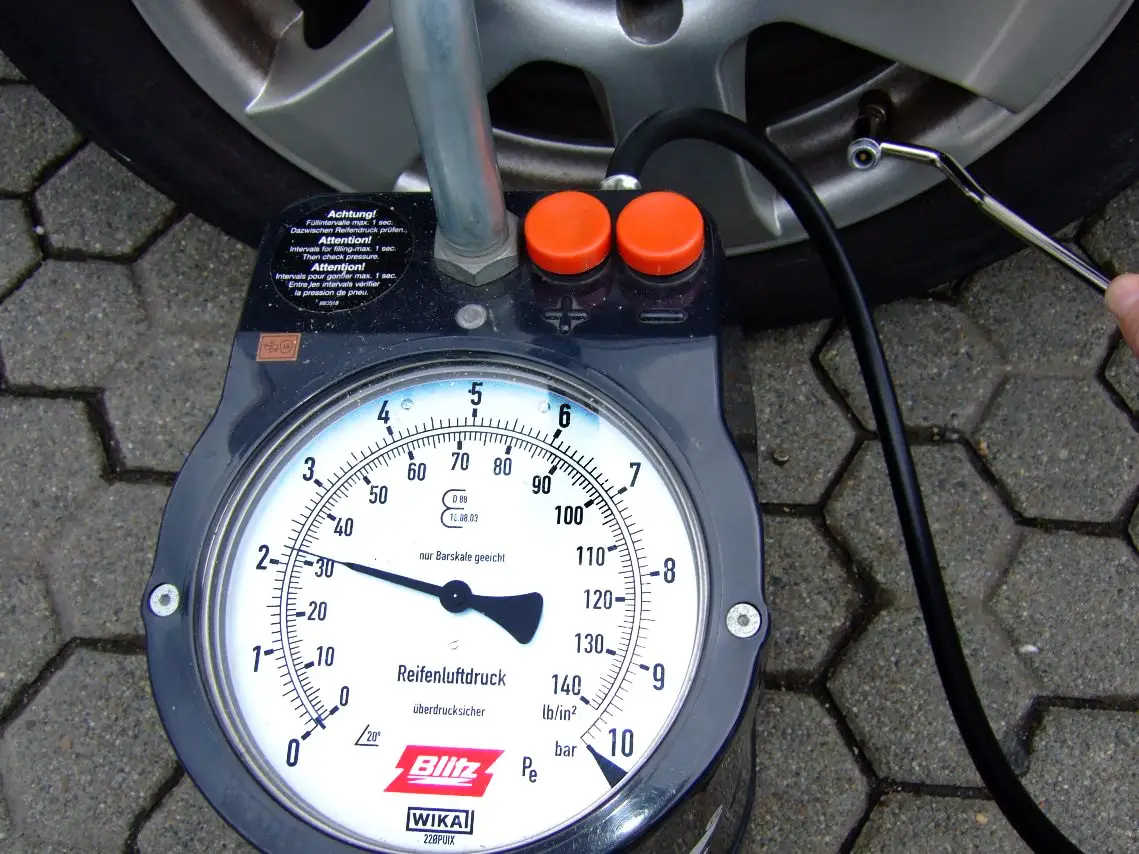
An analog tire pressure gauge and its air chuck beside a car tire. Photo: JEG14 / Wikimedia Commons, public domain. Gauge markings enhanced by Ich.
Choose a gauge that displays the units used on your vehicle’s pressure label. For a model with selectable units, confirm the selected unit before taking a reading. Check screen contrast, backlighting, pointer visibility, or scale markings according to the conditions in which you will use it.
For a digital gauge, check the battery type, replacement procedure, and low-battery indication. Auto shutoff may help conserve power. Follow the model’s published operating and storage limits, particularly if you plan to keep it in a car during hot summers or cold winters.
Store any gauge where its measuring head, hose, and display are protected. Follow the manufacturer’s maintenance instructions if it is dropped, damaged, or starts behaving unexpectedly.
Use this table to compare formats, then verify the specifications of the actual product.
| Type | Practical appeal | What to check |
|---|---|---|
| Digital | Numeric display; some models offer backlighting and selectable units. | Accuracy specification, battery needs, operating limits, and reading-hold behavior. |
| Mechanical dial | Pointer display with battery-free pressure measurement. | Scale divisions, viewing access, connector design, and accuracy across the range. |
| Mechanical pencil | Compact sliding-scale design with battery-free operation. | Readable graduations, suitable range, units, and valve fit. |
A useful digital vs analog tire pressure gauge comparison considers the individual products. Display format alone does not establish which one will give the more accurate measurement.
When comparing retailer listings, match the exact model number with the manufacturer’s information. Brand reputation and customer reviews can provide context, but neither substitutes for a usable specification.
Locate the Tire and Loading Information label, commonly on the driver’s door edge or doorjamb, or consult the owner’s manual. Note any differences between front and rear pressures and check the spare-tire instructions separately.
Use the vehicle’s recommended cold pressure as your reference. The maximum pressure printed on a tire’s sidewall is not the vehicle’s routine inflation target.
Michelin’s pressure-checking guide explains the basic measurement process. Avoid repeatedly venting air while trying to obtain a reading.
Do not release air solely because a warm tire reads above the cold-pressure recommendation. Follow the vehicle’s guidance and recheck when cold. Persistent pressure loss or visible tire damage needs inspection by a tire professional; see Michelin’s maintenance guidance.
Watch: JACO ElitePro Tire Pressure Gauge Demonstration
Video: JACO, the manufacturer. Watch the original demonstration on YouTube. Follow your gauge’s instructions and your vehicle placard’s recommended cold tire pressure.
Confirm the units, valve seal, and gauge reset procedure first. If results remain inconsistent, follow the manufacturer’s service guidance or ask a tire professional to check the instrument against a suitable reference. Agreement between two unverified gauges does not by itself establish their accuracy.
If you also need a pump, our portable tire inflator buying guide explains options to consider alongside your gauge.
Check at least monthly and before a long trip, following vehicle-specific guidance. Include the spare where applicable. NHTSA recommends monthly cold-pressure checks, and Michelin also advises checking before long journeys.
No. Compare the actual products’ accuracy specifications, working ranges, and operating conditions. Display resolution is a separate characteristic. An extra decimal place does not establish superior accuracy.
Yes, keep a suitable gauge for routine pressure checks. NHTSA explains that TPMS warnings indicate significant underinflation and do not replace regular tire maintenance.
Check the model’s operating-temperature range and battery instructions. Cold-weather suitability is a product-specific specification. Investigate weak batteries or unreliable readings according to the manufacturer’s guidance.
Choose a tire pressure gauge that matches your vehicle’s pressure requirements and is easy for you to connect, read, and maintain. Compare accuracy separately from display resolution, then establish a regular cold-pressure checking routine. A well-chosen gauge becomes useful through correct, consistent use.